
In context: this report covers a source published on 16 Sept 2026.
The European Insurance and Occupational Pensions Authority (EIOPA) published an article on 16 September 2026 titled “Scaling AI in finance: systemic risks, resilience and European sovereignty”. The page classes it as a magazine piece, and the download is labelled as a Eurofi article. No author is named; three contributors are thanked.
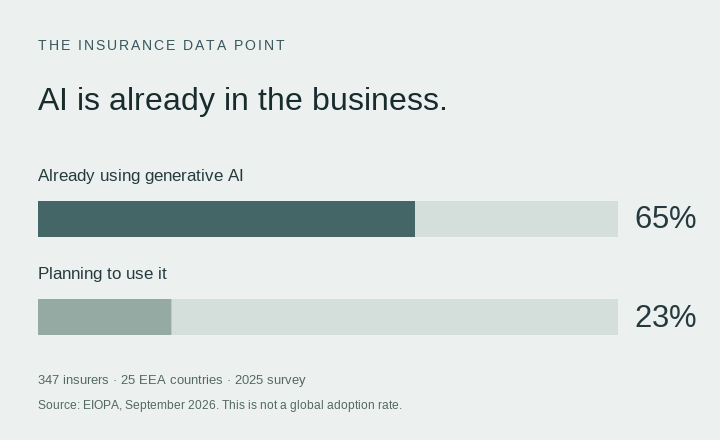
The article starts from EIOPA's 2025 generative AI market survey of 347 insurers in 25 European Economic Area countries. Of the respondents, 65% already used generative AI and a further 23% planned to. The survey also found that 59% considered the AI Act's generative AI provisions useful or very useful. These shares describe the surveyed firms only, not all insurers.
EIOPA's concerns fall into two groups. The first is structural: as insurers buy more models, cloud capacity and integration from outside firms, their dependence on those firms grows, and the market may become more concentrated and interconnected. EIOPA also points to correlated behaviour between models and to dependencies that many models and integrators share. The second group is cyber. EIOPA expects advanced AI to make attacks more sophisticated and to help automated fraud and social engineering, and it says the resulting risk may be more dynamic and harder to capture with traditional actuarial approaches. The European supervisory authorities also agree with a recent European Systemic Risk Board warning about systemic cyber risk from frontier AI models.
On policy, EIOPA's view is that the EU does not need “another broad layer of AI regulation for finance” at this stage. It wants rigorous implementation of DORA and the AI Act instead. In practice, firms and supervisors should know which providers are material to them, rehearse the failure of a provider or model, prove that their exit plans work and share information better. Firms should also keep human expertise, fallback capacity and enough diversity among their providers.
The article also discusses the Cloud and AI Development Act (CADA), which aims to triple EU data-centre capacity within five to seven years and to set an EU-wide framework for assessing cloud and AI sovereignty. EIOPA says sovereignty supports resilience but is not the same thing: moving from dependence on a handful of non-EU providers to dependence on a handful of EU providers would leave concentration risk largely where it is. For long-term resilience, it says, continued work on competition, interoperability and portability remains essential.
Read the source
EIOPA · Regulator · 16 Sept 2026. This is an original brief based on the linked publication. Company statements and forecasts are attributed to their source.


